Software Engineering Certificate
This program prepares senior engineers and technology executives to lead complex, modern software organizations across the entire development lifecycle. Moving beyond traditional coding frameworks, the curriculum focuses on building high-performance engineering cultures, architecting scalable cloud-native systems, and leveraging AI (Agentic AI) to accelerate delivery.
Embracing AI in software engineering is built into the program. With GIIM trends research suggesting AI could automate or assist with up to 80% of routine coding and development tasks by 2030, mastering AI integration has become essential. Beyond code generation, AI accelerates debugging, enhances system architecture, and streamlines deployment—reducing development cycles and time-to-market by up to 70%.
Rather than just focusing on technical execution, the program emphasizes the strategic and leadership dimensions of software innovation—ensuring leaders can align technical decisions with enterprise business goals, manage technical debt, and deploy secure, ethical, and scalable platforms.

This program (described below) focuses on leading modern software organizations and initiatives across the full development lifecycle, and emerging technologies (e.g., AI). Participants will learn to:
- Apply SDLC methodologies — Waterfall, Agile, Scrum, and prototyping — to information systems analysis and development
- Design integrated enterprise architectures spanning mainframe and cloud, and build scalable, loosely-coupled cloud applications
- Explore the transformative role of Agentic AI and data analytics across the complete software development lifecycle. Learn how autonomous AI agents optimize project estimation, elevate new initiatives, and automate Earned Value Analysis—shifting project management from reactive tracking to proactive, data-driven optimization.
- Apply software engineering fundamentals — estimation and measurement, requirements analysis, and testing/quality assurance
- Implement Agile and DevOps practices, including CI/CD pipelines, containerization/orchestration, and DevSecOps
- Distinguish Agile from DevOps and apply the right combination of frameworks (Scrum, XP, Kanban, Lean) to accelerate delivery

Select at least 4 courses from the following:
Prerequisites: Programming experience with Python, Java.
1. Analysis & Development of IS Services/Applications
This course presents and analyzes various approaches to information analysis and development of organizational information systems within a system development life cycle (SDLC), e.g. the waterfall, concentric, agile, Scrum, and prototyping approaches. Topics include strategic planning for SDLC, front-end and back-end phases of SDLC, project management, CASE methodologies, agile, development, Scrum, and balancing user, organizational, and technical considerations.
2. Integrating Enterprise IT Services: Hybrid Architecture, Microservices, and API Management
Modern digital enterprises rely on complex, heterogeneous systems that must operate cohesively to drive business value. This course focuses on the principles and practices of architecting integrated enterprise ecosystems. Participants will explore how to connect mission-critical legacy infrastructure (including mainframes and core transactional databases) with modern cloud-native platforms, microservices, and third-party SaaS environments.
Through real-world architectural design patterns, candidates will master API management, event-driven messaging, data integration pipelines, and hybrid multi-cloud governance. By learning how to bridge diverse computing environments into a unified, secure, and resilient architecture, participants will gain the technical capabilities required to solve large-scale enterprise integration challenges.
3. Fundamentals of SW Engineering
This course introduces software engineering from a modern, quantitative—analytics and metrics-based—perspective. Designed to bridge foundational software engineering principles with cutting-edge industry practices, the course explores the end-to-end software delivery lifecycle across diverse process models—from lightweight Agile, Scrum, and Extreme Programming (XP) frameworks to large-scale enterprise delivery models (e.g., SAFe).
Participants will move beyond legacy estimation models and manual test design to leverage modern, AI-augmented software engineering paradigms. The curriculum emphasizes AI-assisted effort and cost estimation, automated requirements elicitation, and AI-driven test generation alongside traditional boundary-condition analysis. Candidates will gain hands-on experience using industry-standard toolchains, object-oriented analysis and design (OOAD), and collaborative team practices through real-world, project-oriented scenarios and case studies.
Key Focus Areas & Topics
Software Process Lifecycle Models: Comparative Analysis of SDLC, Agile, Scrum, XP, DevSecOps, & Scaled Enterprise Frameworks
AI-Assisted Estimation & Metrics: Modern Predictive Analytics, AI-Driven Effort/Velocity Estimation, Code Complexity Metrics, & Value Tracking
Automated Requirements Elicitation: User Story Generation, NLP-Driven Specification Analysis, Stakeholder Alignment, & Backlog Refinement
Object-Oriented Analysis & Design (OOAD): Design Patterns, UML, System Architecture Modeling, & Clean Code Principles
Advanced Testing & AI-Generated QA: Boundary-Condition Testing, Orthogonal Array Design, Automated Test Case Generation, & AI-Augmented Quality Assurance
Modern Toolchains & Team Collaboration: CI/CD Integration, Automated Code Reviews, Collaborative Version Control (Git), & Agile Team Dynamics
4. SW Estimation & Measurement
The purpose of this course is to prepare technology leaders and software engineers with the essential practices, models, and analytics required for precise software estimation and measurement. The course focuses on applying proven, data-driven methodologies, automated tools, and predictive metrics that demonstrate tangible value to both technical teams and executive business stakeholders.
Participants will master foundational estimation techniques—including top-down, bottom-up, parametric, analogy-based, and expert judgment approaches—while integrating modern AI-assisted estimation frameworks and telemetry analytics. Moving past legacy manual cost models, the curriculum highlights how to leverage automated predictive tools for scenario modeling, “what-if” risk analysis, and engineering trade studies. Candidates will gain hands-on experience using real-world case studies and modern software telemetry to track project velocity, validate vendor/team estimates, and ensure high-quality delivery on time, on budget, and within scope.
Key Focus Areas & Topics
Foundational & Modern Estimation Techniques: Analogy, Parametric, Top-Down, Bottom-Up, & Expert Judgment Frameworks
AI-Assisted & Predictive Estimation Models: Leveraging Machine Learning & Historical Telemetry to Forecast Effort, Velocity, & Costs
Quantitative Software Metrics: DORA Metrics (Deployment Frequency, Lead Time, MTTR, Change Failure Rate), Code Complexity, & Defect Density
Risk Bounding & “What-If” Trade Studies: Scenario Analysis, Monte Carlo Simulations, Risk-Adjusted Cost Profiling, & Scope Trade-offs
Estimating Across Modern Lifecycles: Adapting Estimation Models for Continuous Delivery (CI/CD), DevSecOps, Microservices, & Agile/Scrum
Executive Status & Progress Reporting: Translating Technical Metrics into C-Suite Dashboards, Budget Validation, & Schedule Predictability
5. Software Requirements Analysis & Architecture Specification
Often recognized as the most critical and challenging phase in software development, requirements engineering bridges the gap between ambiguous business needs and precise technical execution. This course equips software leaders, product managers, and engineers with the strategic frameworks and automated tools needed to identify key stakeholders, uncover implicit business requirements, and transform complex needs into actionable, testable software specifications.
Participants will explore modern requirements engineering techniques—from traditional functional and non-functional decomposition to Agile user story mapping and behavioral modeling. The curriculum highlights how to leverage AI-assisted requirements elicitation to analyze stakeholder input, detect ambiguities, generate edge-case scenarios, and maintain continuous traceability throughout the software lifecycle. Through case histories and project-oriented scenarios using industry-standard tools, candidates will learn to align requirements with software architecture, risk management, and automated quality assurance.
Key Focus Areas & Topics
Stakeholder Identification & Alignment: Uncovering Strategic Intent, Managing Conflicting Priorities, & Facilitating Requirements Workshops
AI-Assisted Elicitation & Analysis: Leveraging NLP & AI Tools to Process Stakeholder Input, Identify Gaps, & Refine Complex Requirements
Requirements Modeling & Specification: Domain Modeling, Use Case Diagrams, User Story Mapping, & Behavior-Driven Development (BDD)
Non-Functional Requirements (NFRs) & Quality Attributes: Defining Metrics for Scalability, Security, Performance, Usability, & Cyber Resilience
Continuous Traceability & Change Management: Managing Scope Creep, Dependency Mapping, & Maintaining Requirements Traceability in CI/CD Pipelines
Quality Assurance & Acceptance Criteria: Defining Testable Acceptance Criteria, Automated Requirement Validation, & Risk Mitigation
6. SW Testing and Quality Assurance
Effective, automated software testing is the hallmark of trustworthy, cyber-resilient enterprise systems. In this course, participants explore the full spectrum of modern testing methodologies and quality assurance (QA) frameworks required to certify high-quality software systems across complex, distributed environments.
Coupled with real-world case histories and hands-on lab scenarios, participants will master both structural (white-box) and functional (black-box) testing approaches. Moving beyond manual test matrices, the course highlights AI-assisted test generation, automated regression suites, continuous integration testing in CI/CD pipelines, and advanced boundary-condition analysis. Candidates will explore risk-based testing, chaos engineering, non-functional performance benchmarking, and automated security verification to certify software reliability, performance, and compliance at scale.
Key Focus Areas & Topics
Modern QA Frameworks & Test Automation: Integrating Automated Unit, Integration, System, & End-to-End (E2E) Testing into CI/CD Pipelines
AI-Driven Test Generation & Maintenance: Leveraging AI and Predictive Tools for Autonomous Test Script Generation, Self-Healing Tests, & Smart Test Selection
Structural & Functional Test Design: Boundary-Value Analysis, Equivalence Partitioning, State-Transition Modeling, & Combinatorial/Orthogonal Array Test Optimization
Non-Functional Testing & Benchmarking: Performance, Load, Stress, and Concurrency Testing to Validate Latency & Scalability SLAs
Risk-Based & Security Testing: Threat-Informed Test Planning, Negative Testing, Automated Static/Dynamic Application Security Testing (SAST/DAST), & Chaos Engineering
Software Reliability & Quality Metrics: Defect Tracking, Test Coverage Metrics, DORA Quality Indicators, & Final Software Reliability Certification
7. Engineering Applications for the Cloud
This course introduces the concepts that are the fundamental properties of applications in the cloud including “autonomy”, “elasticity”, and “statelessness”. It also presents proven guidelines for how to build new components and how to integrate existing applications to leverage the new opportunities provided by Cloud.
After completing this course, participants will understand how to address the major challenges to build scalable and highly available applications in the cloud. They will learn how to achieve scalability based on coupling the components of an application in a “loose manner”, including the major technological underpinning to achieve loose coupling, message queuing. It became clear that avoiding keeping state within components is another key contributor to scalability and high availability. This implies to exchange state within messages. Workload management and watchdog techniques are understood as important for elasticity. The course focuses on the set of best practices to attain significant value from Cloud applications.
Project Management Game: Challenge of Egypt (optional)

This 1-day business simulation is a dynamic business simulation in which IT (and preferably non-IT) managers can come together to enhance their project management skills. In this simulation, a group of participants plays the management team responsible for building the pyramids of Egypt.
To do that, the group goes back in time, where they meet the Pharaoh. The Pharaoh has given his project leader instructions to build a pyramid, so that he can make the journey to the hereafter along with everything that is precious to him. The project leader finds a suitable location for the pyramid, a quarry for the stone, and a village for the workers. He also arranges the infrastructure between these locations. It is the team’s responsibility to get the job done. The team will have to set up a project organization, analyze risks, and create a plan.
During the four rounds of this interactive workshop, the most important aspects of best practices for project management will be experienced. This is done interactively. The building process for a pyramid will actually be simulated, letting the participants experience the control elements of effective/efficient project management. During the building process, all team members have a role within the project management environment. The project team is given the task of building the pyramid within a fixed time. The process is affected by real-life events that actually occurred during that period of time. Throughout the building process, there will be several reflection moments to learn from the Egyptians and from the team’s own experience. At the end of the project, when the pyramid has been built, there will be a project evaluation, and all the instructive points will be described.
8 & 9 Agile & Dev Ops Courses
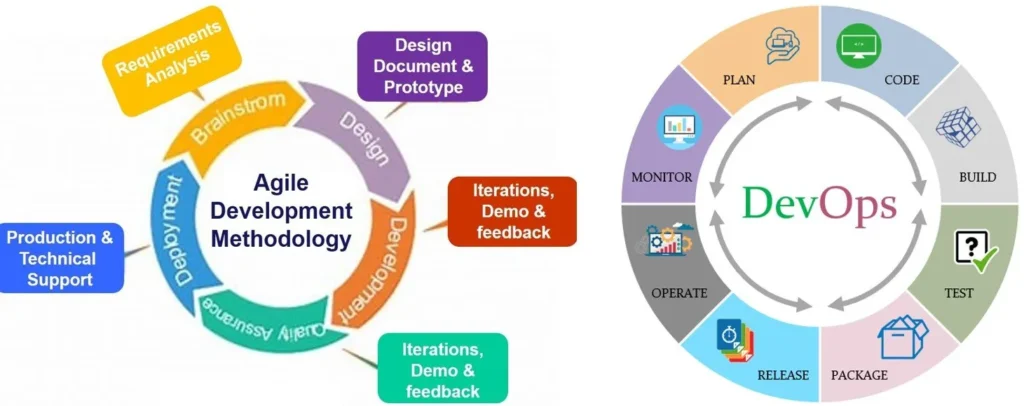
Agile and DevOps courses are offered at both introductory and advanced levels. While both methodologies aim to accelerate software delivery and improve quality, they address distinct phases of the software development lifecycle:
Agile Methods
Primary Focus: Process-driven development, customer collaboration, and iterative feature delivery.
Lifecycle Scope: Covers the development cycle—from product vision and backlog refinement to code completion.
Core Collaboration: Connects developers, product owners, design teams, and business stakeholders.
Key Frameworks: Scrum, Kanban, Extreme Programming (XP), and Lean Software Development.
Primary Goal: Rapidly adapt to changing requirements and deliver small, high-value functional increments to users.
DevOps Practices
Primary Focus: Automated delivery pipelines, cross-team alignment, and continuous infrastructure stability.
Lifecycle Scope: Extends across the complete software engineering lifecycle—including build, test, deployment, monitoring, and operations.
Core Collaboration: Unifies software developers, quality assurance (QA) engineers, site reliability engineers (SREs), and IT operations teams.
Key Frameworks & Tools: CI/CD pipelines, Infrastructure as Code (IaC), container orchestration, and cloud native tools.
Primary Goal: Ensure fast, repeatable, and secure code deployments with near-zero downtime in production environments.
Key Differences at a Glance
Scope: Agile optimizes how software is designed and built; DevOps optimizes how software is delivered, deployed, and run.
Stakeholders: Agile connects development with business product management; DevOps integrates development directly with IT operations and security.
Automation: Agile prioritizes test-driven development (TDD) and iterative execution; DevOps mandates end-to-end automation across builds, testing, security, and cloud infrastructure.
Core Program Considerations
(Shared Executive Framework for Both Agile & DevOps Tracks)
To ensure technical alignment, operational readiness, and real-world impact, every Agile and DevOps course module addresses the following key implementation considerations:
Principles & Core Concepts: Defining foundational methodologies and connecting Lean, Agile, and Adaptive IT models.
Continuous Delivery & CI/CD Pipelines: Analyzing business benefits, deployment options, automated testing, and release management.
End-to-End Service Delivery: Mapping the complete service pipeline from backlog prioritization through automated deployment and continuous monitoring.
Full-Stack Automation: Master build automation, automated testing, deployment orchestration, and Infrastructure-as-Code (IaC).
Tooling & Orchestration: Evaluating popular industry tools, selecting the right deployment modules, and optimizing existing stacks.
Transformation & Success Factors: Reviewing real-world IT transformation case studies, identifying critical success factors, and overcoming adoption challenges (tooling, frameworks, and cultural mindset shifts).
8. Agile Methods for Software Development
In modern software engineering, market demands, complex requirements, and rapid technological shifts make traditional, plan-driven methodologies rigid and high-risk. Agile software development frameworks thrive in these high-velocity environments by fostering collaborative, customer-centric, and highly adaptable team cultures.
This course examines the principles and execution of modern Agile frameworks—including Scrum, Kanban, Extreme Programming (XP), and Lean Software Development—to demonstrate how cross-functional product teams iteratively deliver high-value, quality software. Participants will contrast Agile with legacy plan-driven models and evaluate modern paradigms such as Product-Led Development, scaled Agile, and AI-assisted agile planning. Candidates will master techniques covering the software delivery lifecycle from backlog creation and release planning to sprint execution and continuous customer feedback loops.
Core Learning Objectives & Syllabus Breakdown
1. Foundations of Agile & Modern Product Mindset
Agile Evolution & Values: The Agile Manifesto, Lean philosophy, and transitioning from project-based to product-led delivery.
Agile vs. Waterfall: Evaluating trade-offs between predictive planning and empirical process control.
Building High-Performing Cultures: Fostering psychological safety, self-organizing teams, and cross-functional ownership.
2. The Scrum Framework & Sprint Execution
Scrum Roles & Accountability: Product Owner, Scrum Master, and Developers.
Events & Cadences: Sprint Planning, Daily Stand-ups, Backlog Refinement, Sprint Reviews, and Retrospectives.
Scrum Artifacts: Product Backlog, Sprint Backlog, Definition of Done (DoD), and Increment management.
3. Extreme Programming (XP) & Engineering Discipline
Code-Level Quality: Pair programming, Test-Driven Development (TDD), and continuous refactoring.
Iterative Design: Minimal Viable Products (MVPs), continuous feedback, and evolutionary architecture.
4. Kanban & Flow-Based Delivery
Visualizing Work: Designing effective Kanban boards across complex product streams.
Managing Work in Progress (WIP): WIP limits, bottleneck identification, throughput optimization, and Little’s Law.
Lean Waste Reduction: Value stream mapping, lead time reduction, and continuous process improvement (Kaizen).
5. Product Backlog Management & Agile Estimation
User Story Engineering: Structuring user stories, epic decomposition, and Acceptance Criteria (INVEST framework).
Prioritization & Estimation: Relative sizing (Planning Poker, Story Points) and value-based backlog prioritization (WSJF, Kano Model).
AI in Agile Planning: Leveraging AI tools for user story generation, backlog grooming assistance, and predictive velocity analysis.
6. Agile Metrics, Governance, & Organizational Transformation
Performance Metrics: Burndown/burnup charts, cycle time, lead time, velocity tracking, and flow efficiency.
Tooling Ecosystems: Product management and collaboration platforms (e.g., Jira, Confluence, Trello, Slack).
Agile at Scale & Transformation: Scaling frameworks (SAFe, LeSS) and overcoming cultural friction, organizational inertia, and change management hurdles.
Skills Candidates Will Gain
Agile Leadership & Facilitation: Mastery of Scrum, Kanban, and XP team facilitation.
Product Backlog Strategy: Skillful story writing, estimation, and value-focused prioritization.
Empirical Performance Management: Tracking velocity, cycle time, and team throughput to drive continuous improvement.
Adaptive Product Management: Navigating changing market requirements and managing cross-functional team dynamics.
Career & Leadership Impact
Completing this course prepares technology leaders and practitioners for high-demand strategic roles—including Agile Coach, Lead Scrum Master, Enterprise Product Owner, Agile Delivery Manager, and Software Engineering Manager—empowering them to build resilient, product-led engineering organizations.
9. Dev Ops: Automated Delivery, Cloud Infrastructure, & Dev Sec Ops
Modern enterprise software delivery demands speed, scalability, and continuous reliability. DevOps bridges software engineering and IT operations to shorten development lifecycles, eliminate operational bottlenecks, and ensure reliable, low-risk deployments.
This course focuses on the engineering practices, automation pipelines, and infrastructure architectures that enable high-velocity software organizations. Participants will learn how to design end-to-end Continuous Integration and Continuous Deployment (CI/CD) workflows, manage Infrastructure as Code (IaC), deploy containerized microservices on Kubernetes, and embed security protocols across multi-cloud environments. By combining continuous monitoring, automated testing, and Site Reliability Engineering (SRE) practices, candidates will gain the technical mastery needed to build resilient, automated deployment engines.
Core Learning Objectives & Syllabus Breakdown
1. DevOps Engineering Principles & Site Reliability (SRE)
DevOps & SRE Foundations: The CALMS framework (Culture, Automation, Lean, Measurement, Sharing) and SRE principles (Service Level Indicators/Objectives, error budgets).
Development vs. Operations Alignment: Breaking down operational silos and establishing shared accountability for stability and performance.
Application Scripting for DevOps: Automation fundamentals using Python, Bash, and CLI tools for pipeline orchestration.
2. Continuous Integration & Continuous Deployment (CI/CD)
Pipeline Architecture: Designing automated build, test, and release workflows.
CI/CD Tooling & Orchestration: Configuring pipelines using GitHub Actions, GitLab CI/CD, and Jenkins.
Deployment Strategies: Implementing zero-downtime release strategies (Blue-Green deployments, Canary releases, and Rolling updates).
3. Infrastructure as Code (IaC) & Cloud Provisioning
Declarative Infrastructure: Provisioning cloud resources programmatically to eliminate manual configuration drift.
IaC Toolstack: Authoring, testing, and managing cloud infrastructure using Terraform, OpenTofu, Ansible, and CloudFormation.
Multi-Cloud Delivery: Managing IaC modules across AWS, Microsoft Azure, and Google Cloud Platform (GCP).
4. Containerization & Cloud-Native Orchestration
Docker Fundamentals: Containerizing microservices, writing optimized Dockerfiles, and multi-stage builds.
Kubernetes Orchestration: Deploying, scaling, and managing cluster workloads, service mesh architecture, and ingress controllers.
GitOps & Declarative Operations: Managing Kubernetes cluster state using GitOps tools (e.g., ArgoCD, Flux).
5. DevSecOps & Security Automation
Shift-Left Security: Integrating automated security scanning into the earliest phases of the CI/CD pipeline.
Security Automation Tools: Static Application Security Testing (SAST), Dynamic Testing (DAST), dependency vulnerability scanning, and container image auditing, in light of Zero Trust.
Secrets & Access Management: Secure handling of API keys, tokens, and credentials using HashiCorp Vault and cloud KMS.
6. Continuous Monitoring, Logging, & AI Operations (AIOps)
Observability & Telemetry: Setting up metrics, logs, and distributed tracing across microservices architectures.
Monitoring Stack: Deploying Prometheus, Grafana, OpenTelemetry, and ELK/OpenSearch stacks.
Automated Incident Response & AIOps: Configuring automated alerting, log anomaly detection, and self-healing cloud infrastructure.
Skills Candidates Will Gain
CI/CD Pipeline Engineering: Designing end-to-end automated build, test, and deployment pipelines.
Infrastructure Automation: Writing declarative Infrastructure as Code (IaC) for multi-cloud platforms.
Container Orchestration: Deploying and managing scalable Kubernetes microservices.
DevSecOps Integration: Embedding automated security scanning, policy-as-code, and secrets management.
Enterprise Observability: Configuring centralized logging, metrics dashboards, and automated alerting systems.
Career & Leadership Impact
Completing this course equips candidates for high-demand technical and leadership roles—including DevOps Engineer, Site Reliability Engineer (SRE), Cloud Infrastructure Architect, Platform Engineer, and DevSecOps Specialist—enabling them to lead modern, cloud-native engineering transformations.
10. Managing AI-Driven Software Engineering & AI/Agentic Systems
This course bridges the gap between traditional software development and cutting-edge artificial intelligence. Participants explore the practical impact of AI across the software development lifecycle (SDLC), from initial scoping and estimation to deployment and Earned Value Analysis (EVA). Through hands-on modules focusing on Agentic AI, autonomous workflows, and data governance, students learn to design, build, and manage resilient AI-driven software initiatives.
Module 1: Embracing AI in Software Engineering & Basic Concepts
1.1. Artificial Intelligence Defined & Key Differences
ANI – Artificial Narrow Intelligence vs. AGI – Artificial General Intelligence vs. ASI – Artificial Super Intelligence
Practical impact of ANI vs. AGI on software architecture and task execution
1.2. Core Technical Concepts for Engineers
Neural Networks, Generative Language Models, and Deep Learning paradigms
Supervised, Unsupervised, and Reinforcement Learning applications
Key architectural differences between Discriminative and Generative models
Module 2: AI Software Lifecycle: From Problem Scoping to Evaluation
2.1. The 5 Key Phases of the AI Software Lifecycle
Problem Scoping, Data Engineering, Model Development, Evaluation, and Deployment
Defining necessary conditions for successful model deployment and real-time execution
2.2. Engineering & Performance Optimization
Defining hyperparameter tuning, regularization, and techniques to prevent overfitting
2.3. Strategic Lifecycle Factor Analysis
Critical technical and business factors to consider throughout each lifecycle phase
Module 3: Optimizing Software Development Outcomes with AI: Tools and Techniques
3.1. The Generative & Agentic AI Application Landscape
Architectural scope of generative AI—from LLM coding assistants to autonomous Agentic AI
3.2. Supporting the Software Engineering Team
AI tools designed to support developers, QA leads, technical project managers, and solutions architects
3.3. Leveraging AI Tools Across the SDLC
Practical application of AI tools across planning, requirements, code generation, refactoring, and CI/CD pipelines
Module 4: Governance, Security, and Risk Management
4.1. Key Challenges in Developing AI Software
Technical debt, model drift, non-deterministic outputs, and integration friction
4.2. Data Quality, Privacy, and Ethical Considerations
Ensuring high-quality training/prompt data, maintaining data privacy, and ethical software design
4.3. The AI Lifecycle Data Governance Framework
Structuring compliant data pipelines, auditability, and lineage tracking
4.4. AI-Specific Cybersecurity Threats
Identifying and mitigating prompt injection, data poisoning, model inversion, and supply chain threats
Module 5: Real-World Applications & Ten Business Challenges of Enterprise AI
5.1. Real-World Applications & Case Studies
Analyzing production-grade AI implementations across enterprise SaaS, fintech, and healthcare
5.2. Benefits and Limitations of AI Models
Evaluating cost, latency, accuracy, and operational constraints across model types
5.3. AI-Driven Estimation & Earned Value Analysis (EVA)
Using Agentic AI and data analytics to refine project estimation, track velocity, and automate Earned Value Analysis
5.4. Ten Business Challenges of Bringing AI into the Organization
Overcoming cultural, financial, technical, and operational hurdles when scaling AI initiatives
Module 6: Harnessing the Future: Action Plan for AI-Driven Software Engineering
6.1. Strategy Implementation
Developing a clear organizational strategy for integrating AI into software development lifecycles
6.2. Role of the Engineering Leader & PM in Each Phase
Leadership responsibilities and decision-making throughout strategy execution
6.3. Future Potential AI Improvements
Preparing engineering teams for emerging AI paradigms and their long-term impact on software creation
11. Software Architecture & Design for AI-Assisted Software Engineering & LLM Application Development
Artificial intelligence is redefining the software development lifecycle—moving developers from line-by-line syntax authors to high-level system orchestrators. This course equips senior developers, architects, and engineering managers with the technical capabilities and governance frameworks required to design, build, and deploy AI-native and AI-augmented software systems.
Participants will learn how to integrate Generative AI tools directly into engineering workflows to accelerate coding, debugging, refactoring, and testing. Beyond developer productivity, the course focuses on application engineering: building intelligent applications powered by Large Language Models (LLMs), Retrieval-Augmented Generation (RAG), dynamic AI agents, and vector databases. Candidates will also evaluate critical enterprise concerns, including AI code governance, intellectual property protection, security vulnerabilities (OWASP LLM Top 10), and ethical AI deployment.
Core Learning Objectives & Syllabus Breakdown
1. AI-Augmented Software Development (Developer Productivity)
Generative AI in the IDE: Mastering AI coding assistants (GitHub Copilot, Cursor, Amazon Q) for rapid prototyping, code completion, and refactoring.
AI-Driven Code Quality & Debugging: Using LLMs for automated bug detection, performance profiling, legacy code conversion, and test generation (unit, integration, E2E tests), and Cyber Resilience.
Prompt Engineering for Developers: Structuring system prompts, few-shot examples, and chain-of-thought logic to generate deterministic code outputs.
2. LLM Application Architecture & AI Design Patterns
Building AI-Native Applications: Integrating LLM APIs (OpenAI, Anthropic, open-source models like Llama) into cloud application backends.
Retrieval-Augmented Generation (RAG): Designing RAG pipelines to connect proprietary enterprise data with AI models using vector databases (Pinecone, Milvus, Oracle AI Vector Search).
Agentic Workflows & Multi-Agent Frameworks: Building autonomous AI agents, tool-calling mechanisms, and decision loops using frameworks like LangChain, LlamaIndex, or AutoGen.
3. Enterprise AI Security, Governance, & Ethical AI
LLM Security (OWASP for LLMs): Mitigating prompt injection attacks, data poisoning, insecure output handling, and sensitive data leakage.
IP, Compliance, & Code Governance: Navigating copyright, licensing, and corporate policies regarding AI-generated code and third-party LLM data retention.
Model Monitoring & Evaluation (LLMOps): Tracking hallucination rates, response latency, token consumption costs, and model drift in production environments.
Skills Candidates Will Gain
AI Tooling Mastery: Accelerating development throughput using state-of-the-art AI coding assistants and agents.
RAG & Vector Architecture: Designing secure, retrieval-based search and knowledge systems over enterprise data.
AI System Security: Implementing guardrails and security protocols against prompt injection and data exposure.
LLMOps & Cost Optimization: Managing API token budgets, model selection, latency tuning, and operational monitoring.
Career & Leadership Impact
Completing this course prepares candidates for emerging, high-impact roles—such as AI Application Engineer, Lead AI Systems Architect, Software Engineering Manager (AI Transformation), and Chief AI Architect—positioning them to lead enterprise software organizations through the AI revolution.

Depending on one's background and career objectives, candidates should also consider courses from GIIM's:
