GIIM develops digital transformation-ready leaders who turn Agentic AI, cybersecurity, Multi-Cloud, data, and emerging technologies into measurable business impact.
Current and former CIOs, CTOs, CISOs, CDOs, and global IT and non-IT executives, along with academics/professors, teach the programs and bring real‑world experience, proven frameworks, and industry‑validated leadership models.
GIIM exists to close a critical global gap: organizations have technology but lack leaders who can manage it strategically.
GIIM Vision
To set the global standard in digital executive education through battle-tested expertise and strategic alignment.
GIIM Mission
Empowering leaders at every level to turn digital strategy into business impact, so organizations stop having technologists and start having strategic digital leaders.
Preparing Leaders for the Digital Era
GIIM programs equip candidates with the actionable competencies required to lead in an era defined by AI, automation, and continuous transformation.
GIIM Prepares Leaders Who Can:
Align Strategy: Seamlessly integrate technology goals with enterprise business objectives.
Govern AI & Tech: Establish responsible governance frameworks for Agentic AI and emerging platforms.
Manage Digital Risk: Build cyber resilience and protect enterprise assets.
Drive Data & Growth: Leverage analytics for data-driven decisions and continuous innovation.
Lead Teams: Build and scale high-performing IT and non-IT teams.
GIIM’s Objectives
Set the global standard for digital executive education through battle-tested expertise.
Close the critical leadership gap between technology deployment and strategic management.
Provide flexible, cost-effective executive credentials to organizations globally.
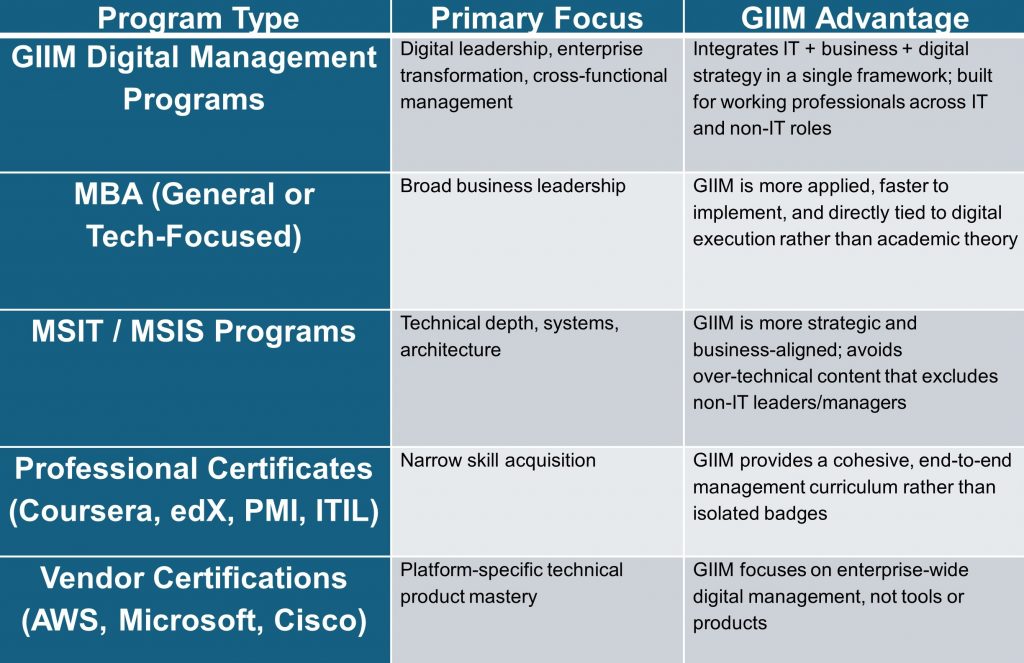
Select above table to learn more about what sets us apart
The Strategic Positioning table compares GIIM’s accredited digital management programs against four traditional educational options, emphasizing how GIIM bridges the gap between high-level theory and standalone technical tools. While MBAs focus broadly on business, MSIT/MSIS degrees emphasize deep technical architecture, professional certificates deliver narrow, isolated skills, and vendor credentials validate specific software platforms, GIIM integrates business, technology, and governance into an enterprise-wide framework designed for both IT and non-IT leaders.