Explore GIIM's 35 Cutting Edge Accredited DigITal Management Programs
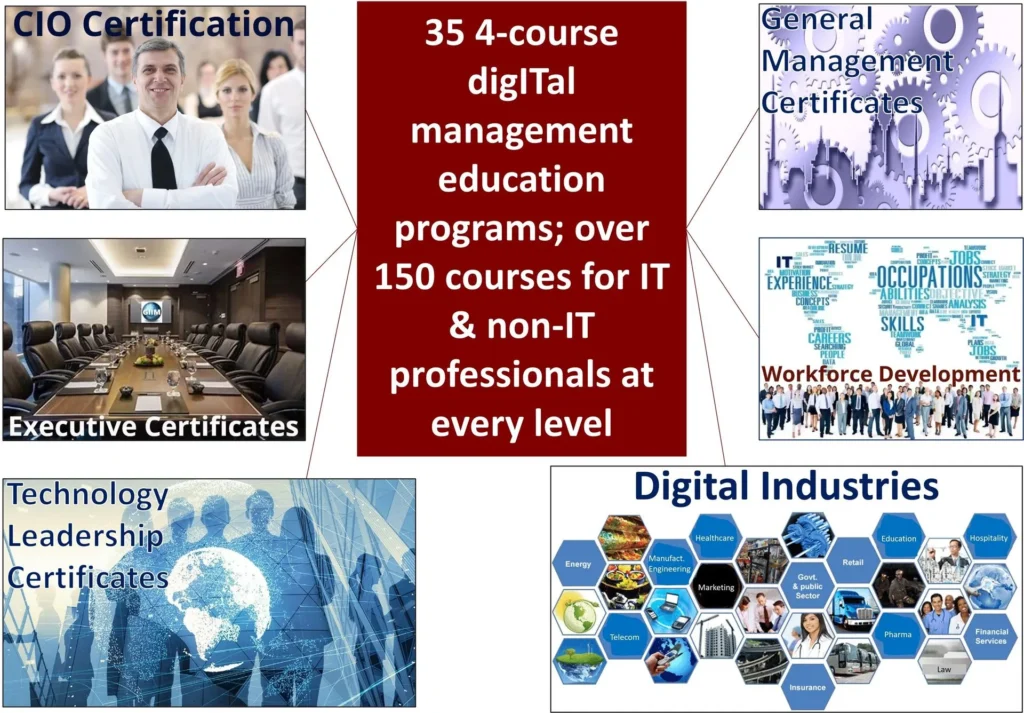
With a selection of 35 programs (over 150 courses),
candidates have unparalleled opportunities to enhance their digITal future
- Select the images or program names below to find out more


- 20. Chief Data Officer (CDO)
- 21. Data for Managers
- 22. CISO; Cyber Security
- 23. Chief AI Officer (CAIO)
- 24. Blockchain
- 25. Cloud Computing
- 26. Chief Technology Officer (CTO)
- 27. Project Management
- 28. Software Engineering
- 29. Social/Mobile Networking
- 30. Technology Enabled Learning
- 31. Workforce Development

35 Executive Programs: Delivered live (in person or online) and tailored to your organization’s and candidates’ strategic goals. Certificates/Certification require 4 courses.
Flexible Learning: Core programs available asynchronously online and in blended/hybrid formats.
Practical Excellence: Built to balance rigorous academic research with immediate, real-world impact.
AI Integration: AI governance and leadership are integrated where relevant across the portfolio.
What You Will Learn
Working with GIIM across its portfolio of 35 digital management education programs equips IT leaders, business executives, and cross-functional teams with the strategic, technical, and operational fluency needed to lead in a digital-first economy. Grounded in a practical mini-MBA framework, participants' across these programs learn to:

Drive Business-IT Strategic Alignment
Formulate and execute technology-enabled business strategies, optimize digital capabilities, and align IT and business investments directly with revenue growth, operational excellence, and sustained competitive advantage.
Master Executive Leadership & Organizational Governance
Establish robust enterprise governance, lead global and cross-functional teams, manage organizational change, and structure IT operations and financial models to demonstrate clear business value.
Architect Modern Sourcing, Ecosystem & Vendor Strategies
Make sound sourcing decisions (in-house, cloud/SaaS, onshore, nearshore, offshore), lead strategic vendor negotiations, and manage complex supplier ecosystems and contract life cycles.
Evaluate & Deploy Emerging Technologies at Scale
Assess, architect, and integrate transformative technologies (e.g., Agentic AI, Multi-Cloud Governance, Cyber Resilience, blockchain) using rigorous business-case, ROI, and risk-management frameworks.
Deliver High-Impact Domain & Industry Transformation
Apply specialized leadership practices tailored to key C-suite and advisory roles (e.g., CIO, CTO, CISO, CDO, CAIO, Management Consultant, Business Analyst) as well as specific industry verticals to drive measurable enterprise performance.
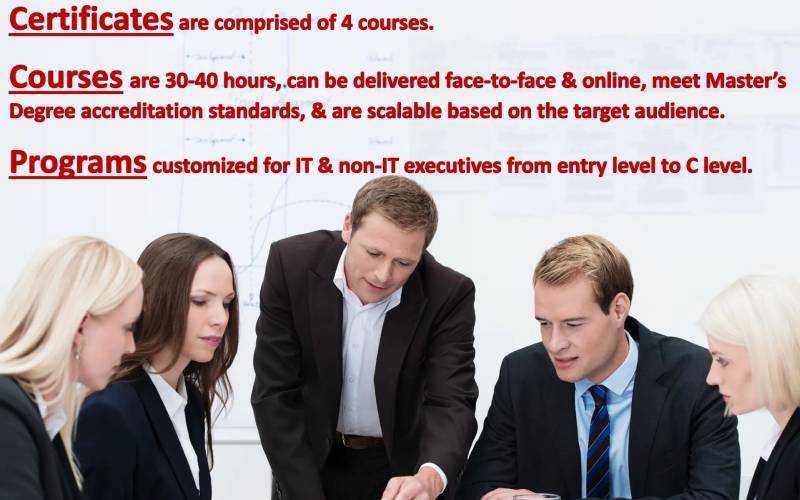
- Each accredited 40-hour course is a component of a detailed and adaptable 4-course certificate program, tailored to the candidates’ backgrounds and goals.
- All programs have been meticulously crafted by top academics and professionals to cover every facet of the subject matter, ensuring the achievement of utmost proficiency.

All Courses Are
- All courses are offered in live (synchronous) formats, allowing participants’ to engage in real-time sessions either face-to-face or online, depending on their preference and location.
- These sessions are customized to suit the unique needs, professional levels, and learning objectives of the target audience, ensuring maximum relevance and impact.
- For greater flexibility, the most in-demand programs are also available in asynchronous online formats, enabling learners to access the material at their own pace.
- Blended learning options are also available. They combine the benefits of live interaction with the convenience of self-paced learning, providing a well-rounded educational experience tailored to busy professionals.
Program & Candidate Tiers and Pathways
- Every GIIM program is designed to deliver immediate value regardless of participants’ starting point.
- Whether you are building foundational skills or preparing for the C-suite, there is a clear pathway for you and your organization.
- Recognizing that every professional brings a unique perspective and set of objectives, we customize each candidate’s program pathway based on their specific background, prior experience, and career objectives.
- This tailored/tiered approach ensures that non-IT managers and executives gain the technical clarity needed to drive digital strategy, while IT leaders acquire the executive management tools required to lead organizational transformation.
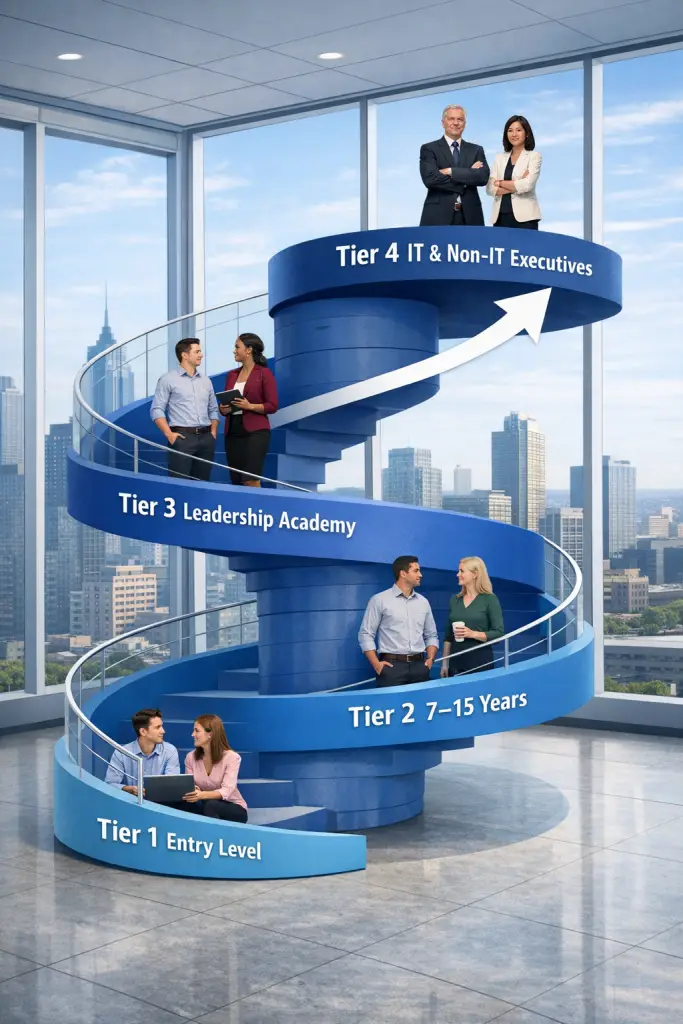
Build a learning pathway around your organization’s priorities. GIIM works with enterprises, universities, associations, and advisory organizations to deliver live, online, or blended programs that can be tailored to a defined audience, capability goal, and schedule.
Four Tiers of Experience Framework
The Global Institute for IT Management (GIIM) structures its executive and professional education into four tailored career stages:
Tier 1 (Entry Level): Designed for foundational professional growth, featuring 4-course certificate programs focused on workforce development and core technical/management tracks.
Tier 2 (7–15 Years Experience): Targeted at mid-career leaders seeking 4-course certificates tailored toward specialized domain leadership, industry-specific programs, and emerging tech management.
Tier 3 (Leadership Academy): Tailored for senior candidates preparing for high-level organizational leadership, offering advanced 4-course certificates requiring prior management experience.
Tier 4 (IT & Non-IT Executives / C-Level): High-impact single-course executive seminars and strategic briefings built specifically for C-suite leaders (CIOs, CDOs, CAIOs, CISOs, CTOs) and senior decision-makers leveraging digital strategy.

Four Tiers of Experience
European Qualifications Framework (EQF)
1. Tier 1: Foundational/Early‑Career Experience: 0–7 years EQF Levels 3-5
- Focus: Technical execution and skill development
- Typical Roles:
- Help desk / support analyst
- Junior developer
- Systems/Network technician
- QA tester
- Entry‑level cybersecurity or data roles
- Characteristics:
- Building core technical competencies
- Task‑oriented, supervised work
- Limited architectural or strategic responsibility
- High learning velocity; strong candidates move quickly into Tier 2
2. Tier 2: Mid‑Career/Operational Leadership Experience: 7–15 years EQF Levels 5-7
- Focus: Managing systems, teams, and cross‑functional delivery
- Typical Roles:
- Senior engineer / senior developer
- Systems, network, or cloud engineering
- IT project manager / Scrum master
- Business analyst / ERP analyst
- Cybersecurity engineer
- Data analyst / data engineer
- First‑line or mid‑level IT manager
- Characteristics:
- Owns platforms, applications, or service domains
- Leads small to mid‑sized teams
- Translates business needs into technical solutions
- Increasing influence on architecture, governance, and standards
- Often the pipeline for future IT directors and VPs
3. Tier 3: Senior/Strategic Leadership Experience: 15–25+ years EQF Levels 7-8
- Focus: Strategy, alignment, governance, organization, business/management, enterprise architecture, industry trends, and transformation
- Typical Roles:
- CIO
- CAIO
- IT Director
- VP of IT
- CTO
- CISO
- CDO
- Characteristics:
- Sets technology strategy and investment priorities
- Leads enterprise‑wide transformation (cloud, cybersecurity, data, AI)
- Manages budgets, risk, vendors, and governance
- Aligns technology and business outcomes
- Represents IT at the executive table and with the board
4. Tier 4: IT & Non-IT Executives Including C-Level; Beyond EQF
- Focus: Concentrated program dedicated to leveraging IT for competitive advantage, strategy, alignment, governance, industry trends, organization/reporting, business/roles & responsibilities, sponsor and champion leadership, management, and transformation decision making
- Typical Roles:
- CIO
- CEO
- CFO
- VP of Marketing
- BU Executive
- Characteristics:
- Sets technology strategy and investment priorities
- Sponsor and champion of digital initiatives
- Manages budgets, risk, governance
- Aligns technology and business outcomes
- Represents the enterprise at the executive table and with the board
Why This Matters for Boards and Executives
- Build skills‑based career pathways
- Identify leadership pipelines
- Align compensation and expectations
- Plan for succession, especially for C-level roles
- Prepare sourcing strategies
- Understand where candidates will reshape work across tiers
Strategic Positioning
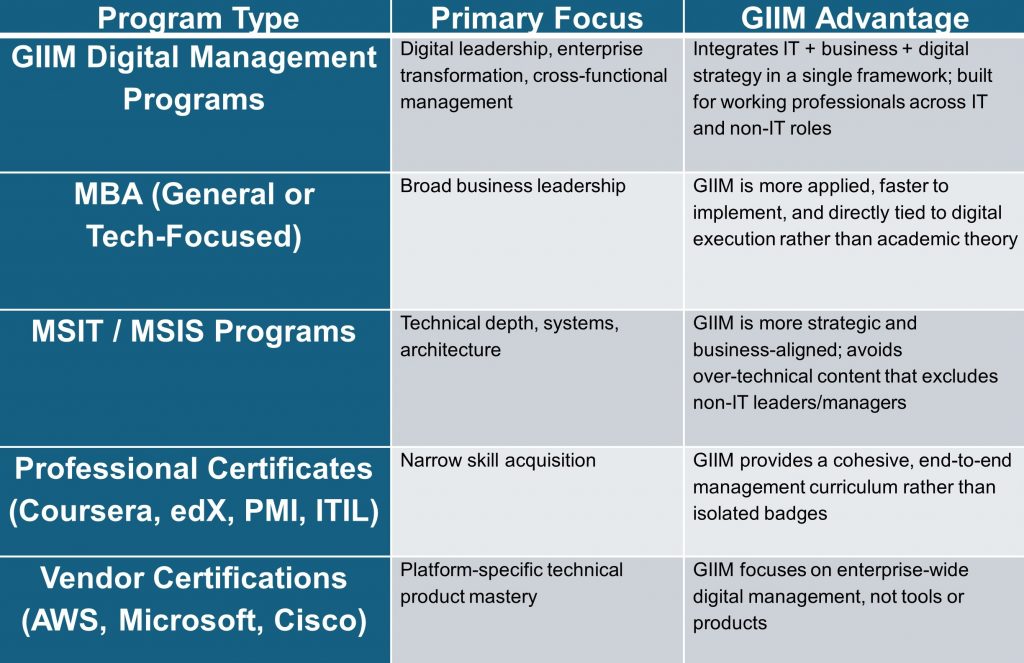
The Strategic Positioning table compares GIIM’s accredited digital management programs against four traditional educational options, emphasizing how GIIM bridges the gap between high-level theory and standalone technical tools. While MBAs focus broadly on business, MSIT/MSIS degrees emphasize deep technical architecture, professional certificates deliver narrow, isolated skills, and vendor credentials validate specific software platforms, GIIM integrates business, technology, and governance into an enterprise-wide framework designed for both IT and non-IT leaders.

All courses are available live / synchronously (face-to-face & online)

All live courses are customized based on the target audience & their objectives
AI is integrated into every program

Why Choose Us
- Technical training builds skills; GIIM builds digital strategy and executive leadership. No other institution matches the breadth and strategic rigor of our digital management curriculum.
- All programs have been meticulously crafted by top academics and professionals to cover every facet of the subject matter, ensuring the achievement of utmost proficiency.
Exemplary Faculty
- Dedicated to preparing digITal leaders!
- Focused on digITal management insights for a rapidly changing world.