Synchronous Blended
If affiliates want the flexibility of self-paced online learning paired with the structured accountability and peer interaction of live discussions, this format is best.

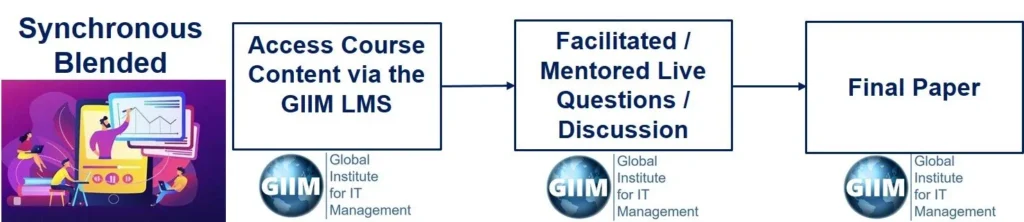
Self-Paced Core: Complete ~30 hours of asynchronous online lectures delivered by GIIM subject matter experts (or local facilitators prepared by GIIM) at your desired pace.
Live Mentorship & Discussion: Engage in 10 hours of scheduled live sessions (face-to-face or virtual) facilitated by experienced mentors to discuss real-world applications, group case studies, and projects.
Flexible Pacing: Cohorts are structured around weeknight or weekend sessions, allowing you to complete each certificate course in a timeline that fits your career demands.
Practical ROI: Apply key course concepts directly to your organization through a tailored final project.

Blended / Hybrid Schedule
The blended/hybrid delivery option includes leveraging GIIM or local faculty to augment the 30+ hour asynchronous online/web lectures delivered by GIIM faculty using the GIIM LMS. Local faculty are used for the blended/hybrid delivery model when it is not cost-effective to use GIIM faculty.
This provides candidates’ with the ability to experience the GIIM subject matter experts while having the local faculty’s understanding of the local cultural, economic, language, and business considerations.
Most affiliates conduct five (5) 2-hour live face-to-face (f2f) sessions to supplement the online asynchronous lectures. These f2f meetings (some affiliates use live synchronous online meetings) use local faculty (when it is not cost-effective to use GIIM faculty) who would mentor, advise, and facilitate lectures, group discussions, case studies, and projects. Local mentors/facilitators are prepared by GIIM faculty via an effective T3 (Teach-the-Teachers or Train-the-Trainers) model.
With each course typically being 30 1-hour asynchronous online lectures (keep in mind that some courses have a few more or a few less), most affiliates schedule the f2f class discussions after every 6 modules (6 hours of asynchronous lectures), where students/candidates’ would meet after completing modules:
- 1 – 6
- 7 – 12
- 13 – 18
- 19 – 24
- 25 – 30
Students would then submit their final papers after the last meeting.
To shorten the length of time to complete each course, some affiliates run three (3) 4-hour f2f class discussion sessions:
- 1 – 10
- 11 – 20
- 21 – 30
GIIM works with its affiliates to derive an effective, efficient schedule and pricing model. As for how and when to schedule the f2f meetings, it depends on the affiliate and who their candidates’ would be.
In some cases, affiliates hold the f2f class discussions on the weekend and others on weeknights.
The actual schedule depends on how long the affiliate would like to allow candidates to complete each certificate.
- Candidates/students normally require 2 weeks to complete their final paper that applies the content of the course to their jobs or desired career. As part of the class discussions, candidates often complete and discuss different aspects of their final paper throughout the course.
- The actual frequency/schedule for the f2f class discussions depends on whether the candidates are working or not and how long the affiliate believes the 4-course certificate should take. To finish six (6) to ten (10) 1-hour asynch lectures ordinarily requires a full week.
- If affiliates want to have the 4-course certificate completed in 6 months (26 weeks, not considering holidays), that means having each course completed (including the final paper) in 4.5 weeks
- Candidates are assessed/graded based on practical real-world projects that apply the content of the course to the candidate’s job or career aspirations
Local faculty (non-GIIM faculty) are used for the synchronous blended/hybrid delivery model when it is not cost effective to use GIIM faculty. In addition, the use of local faculty:
- provide candidates with the ability to experience the GIIM subject matter experts, while having the local faculty’s understanding of the local cultural, economic, language, and business considerations
- mentor, advise, and facilitate lectures, group discussions, case studies, and projects.
- are prepared by GIIM faculty via an effective T3 (Teach-the-Teachers or Train-the-Trainers) model.
- are hired and managed by the local affiliate and approved by GIIM.
- while good facilitation experience is essential, the more subject matter expertise that they have, the better.
- based on their background, they would take the respective asynchronous course and receive discussion questions and suggested projects to use during the blended sessions.
Asynchronous Blended is also available