More About GIIM's AI Program

AI (Agentic AI) has become pervasive, shaping strategy, decisions, operations, and human behavior in ways few leaders could have imagined even five years ago.

The central question is no longer whether AI (Agentic AI)  will replace human capability, but how leaders integrate the strengths of both to unlock new levels of innovation, productivity, and enterprise value. The future isn’t a choice between humans and AI; it is a leadership challenge to orchestrate the best of both.

GIIM’s programs are built precisely for this moment: equipping IT and non-IT leaders to harness human and artificial intelligence together, so each amplifies the other toward measurable business impact. With AI initiatives still underperforming traditional projects on both success rate and ROI, this program exists to give organizations the disciplined, execution-ready leadership needed to close that gap by preparing current and future CAIOs (and other digital stakeholders) to turn AI capability into measurable value and redefine customer engagement.

80% of US CEOs believe they could lose their jobs within 2 years if they fail to deliver measurable business gains from AI. Over 25% have a CAIO.

Core Focus Areas:

  • Strategic AI Alignment — Identifying and prioritizing high-value AI use cases across business units to drive efficiency and growth
  • Enterprise Governance & Risk — Navigating the legal, ethical, and security considerations of AI deployment, including bias, data privacy, and intellectual property
  • Organizational Readiness — Preparing your workforce for AI adoption, restructuring workflows, and upskilling teams, with no prior technical background required
  • Evaluating Emerging Tech — Frameworks for assessing generative AI, machine learning models, and vendor solutions to make smart build-vs-buy decisions

GIIM works closely with each affiliate to align the program with your industry’s regulatory realities and organizational maturity, so your leadership team is fully prepared to lead with confidence.

Despite massive investment, most businesses have struggled to show measurable AI results:

  • PwC’s Global CEO Survey: 56% of CEOs reported neither increased revenue nor decreased costs from AI in the last 12 months
  • Gartner: only 5% of CFOs reported cost reductions from AI, and only 6% reported revenue increases
  • MIT’s NANDA project: only 5% of integrated AI pilot programs deliver significant financial returns; the vast majority show no measurable impact on profit and loss
  • Although 80% of enterprises have explored AI, only 40% have moved to deployment, and half of all AI initiatives fail outright — just 20% reach pilot stage, and only 5% reach full production

This pattern echoes the “productivity paradox” debates of the 1980s. According to McKinsey’s State of AI survey, 78% of companies now use AI in at least one function (up from 55% in 2023) — yet results remain modest: cost savings under 10%, revenue increases under 5%. As one former JPMorgan research head put it, current AI enthusiasm shows signs of a bubble.

The core lesson: value doesn’t come from the technology itself.  It comes from how a business changes what it does to leverage that technology. Applying AI to inefficient, ineffective processes doesn’t unlock value; it just masks dysfunction. Modernize your foundation, or your AI investment gathers dust.

GIIM addresses these and more

After successful completion of this program, candidates will also receive an ICCP or IOA Certification!!!

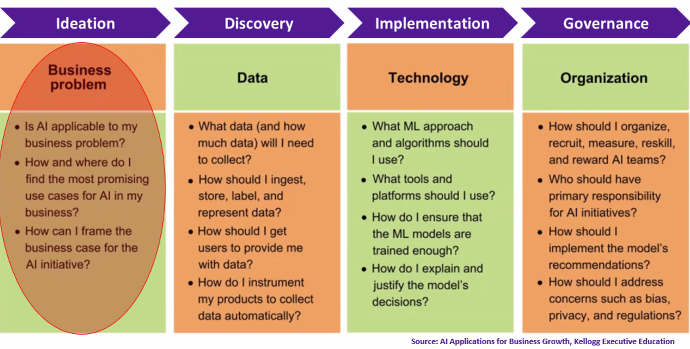
The entire AI Adoption Life Cycle & Capability Maturity Models are Addressed

5 Common Mistakes That Impede AI Success

1. Confusing “doing AI” with creating enterprise value. AI isn’t a trophy project — it’s a data-driven discipline that requires real investment in capability, operating mechanisms, and governance. Success depends on building advanced data capabilities, engaging stakeholders across the business, and tying every initiative to measurable value.

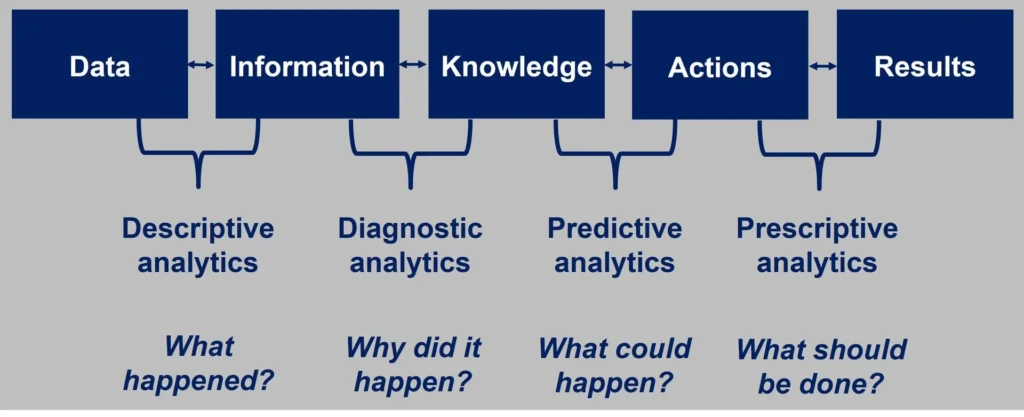
2. Launching AI initiatives without a defined value pathway. Individual productivity gains don’t automatically translate into enterprise value. A disciplined path — from data, to insight, to action, to monetized value — is what separates experimentation from real impact.

3. Staying stuck in pilots instead of scaling. The financial upside only emerges once organizations redesign work, systems, and governance around AI-enabled operating models — aligning investment with strategy, building interoperable platforms, developing AI-ready teams, and embedding responsible AI practices.

4. Underestimating how AI transforms the business model. AI is becoming a catalyst for entirely new business models — from AI-enhanced existing offerings, to AI acting as a “customer proxy,” to AI assembling modular, personalized outcomes. These shifts require rethinking value propositions and governance, not just processes.

5. Mistaking productivity gains for enterprise value. Individual productivity tools (drafting, summarizing) are real but limited. True enterprise value comes from AI solutions that integrate with systems and workflows to drive revenue, efficiency, and customer outcomes — not just tools that speed up individual tasks.

Value of AI

What This Means for the Workforce

AI is automating pieces of jobs, not entire roles — companies are using it to boost productivity 20–25% on specific tasks, largely without wholesale layoffs. Where cuts have happened (an estimated 49,000+ this year, at companies including Block, Coinbase, and Cloudflare), it’s mostly been through streamlining teams rather than eliminating full positions. Roles are evolving instead: software engineering, for instance, is shifting toward new titles like “builder,” where AI assists with code while humans still own problem-solving and design decisions.

That said, real change is coming to specific functions:

  • Administrative and process-support roles: the World Economic Forum projects a 35% reduction in traditional office support roles by 2030
  • Customer service: over 40% of roles could be automated by 2028, as conversational AI handles increasingly complex interactions
  • Even highly specialized fields like medicine and education may see AI democratize access to expertise that’s traditionally been scarce

As with prior technology shifts, we’ll likely overestimate AI’s impact over the next 3 years, and underestimate it over the next 10. The professionals who succeed will be the ones who collaborate with AI rather than compete with it — building adaptable skills like creativity, complex problem-solving, and emotional intelligence, the areas where AI still falls short.

New roles are emerging as a direct result: prompt engineers, AI compliance specialists, AI product managers, AI data annotators, and AI ethics advisors, alongside rising demand for established skills like predictive analytics, NLP, and machine learning.

Where are you in the AI race?

Enterprise AI Transformation is a Progression NOT an On-Off Switch

AI Governance Components

AI Governance Maturity

Governance Can’t Be an Afterthought

AI is reaching a critical inflection point. Like other dual-use technologies before it (nuclear energy, the web, even the printing press), advanced AI concentrates capability, scales rapidly, and produces effects that cross borders — meaning purely local or firm-level controls aren’t enough.

History suggests effective governance doesn’t inhibit innovation — it stabilizes it. The technologies that endured did so through use-based controls (not blanket bans), graduated access to sensitive capabilities, and real transparency through audits and incident reporting. AI governance is beginning to follow the same path, with policymakers converging on risk-based approaches and shared norms for responsible development.

What CEOs are saying about AI

  • 68% plan to spend even more 
  • Less than half of current projects had generated more in returns than they had cost.
  • Most successful: marketing and customer service
  • Biggest challenges: higher-risk areas such as security, legal, and human resources

The Successful CAIO Ensures:

AI adoption is accelerating across industries, yet many organizations still struggle to translate that investment into measurable business value.

The pattern is reminiscent of the poor project success rates, and the Productivity Paradox debates of the 1980s. The question now is whether this is simply history repeating itself—or whether today’s leaders are falling into the same execution and governance gaps that limited returns in the past.

Agentic Layers

            Program Fit

This program is delivered as an independent 4-course certificate, or as part of the broader Deploying Analytics Certificate (covering Big Data, Business Intelligence, and Knowledge Management) or Technical Training Certificate. Depending on your background and goals, some prerequisite courses may apply.

Candidates leave equipped to harness AI technologies against real business objectives — identifying new customer opportunities, maximizing efficiency, and driving profitable growth — with a full understanding of the technical, managerial, legal, and ethical considerations behind selecting and applying the right AI technology; especially Agentic AI.

Agentic AI

agentic ai

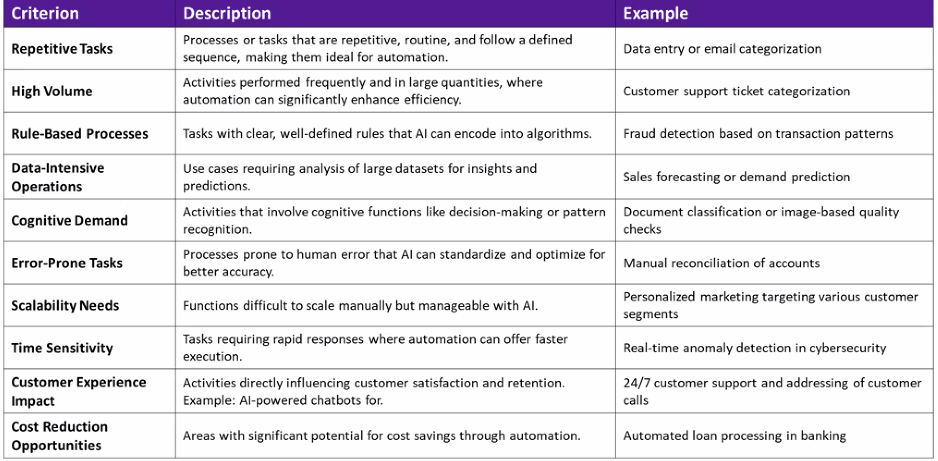
Criteria for Identifying AI Application Candidates

Insanity – Doing the same thing over and over again and expecting different results.

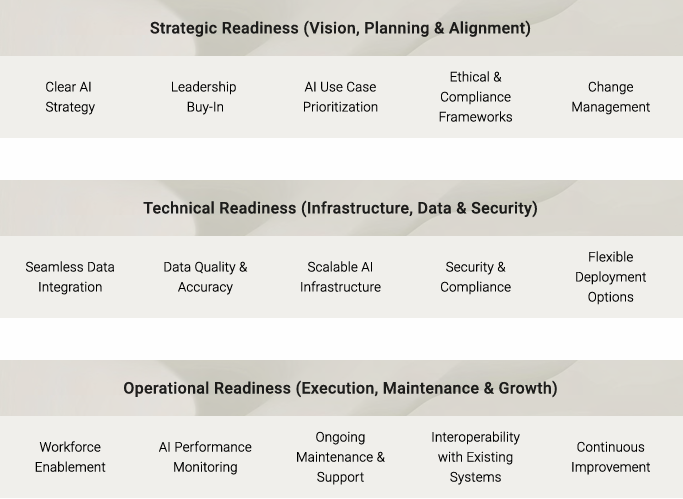
Are you AI ready?

Back-office, administrative roles that involve routine documentation, scheduling, and communication are increasingly leveraging AI tools capable of performing these tasks with minimal human oversight, reflecting the economic warnings from experts.

Process support roles are experiencing unprecedented opportunities from AI automation. Administrative professionals who do not upskill quickly may find themselves competing for a dwindling number of positions. The World Economic Forum projects a 35% reduction in traditional office support roles by 2030.

               10 Popular AI Use Cases:

  • Service process optimization
  • New AI-based products & services
  • Customer service analytics
  • Customer segmentation
  • Product research & enhancement
  • Customer acquisition & lead generation
  • Contact center automation
  • Product feature optimization
  • Risk modeling & analytics
  • Predictive service & intervention

Considered by many as the next industrial revolution, Artificial Intelligence (AI) will be more transformative in a shorter period of time than stone tools, controlled use of fire, the wheel, clothing, agriculture, alphabets, printing, vaccines, incandescent light, telephones, the steam engine, flight, antibiotics, television, computers, the internet, fusion energy, etc.

Is AI Becoming a Runaway Train

AI is reaching a critical inflection point. Like nuclear technology (and other dual-use technologies throughout history, including the web, television, printing press), advanced AI concentrates capability, scales rapidly, and produces cross‑border effects. Systems developed in one country can influence markets, public discourse, and security outcomes worldwide, rendering purely local or firm‑level controls insufficient. History shows that when technologies operate on a global scale, governance must extend beyond national boundaries.

Crucially, effective governance does not inhibit innovation; it stabilizes it. Successful responses to prior dual‑use technologies shared three features: use‑based controls rather than blanket bans; graduated access to the most sensitive capabilities; and transparency and accountability through documentation, audits, and incident reporting. These mechanisms reduced uncertainty, mitigated backlash, and enabled sustainable growth.

AI governance is beginning to follow this trajectory. Policymakers are converging on risk‑based approaches, disclosure expectations, and shared norms for responsible development. While implementations differ, the direction is consistent: high‑impact systems face greater scrutiny, developers bear responsibility for foreseeable misuse, and cross‑border coordination is increasingly essential.

For business executives, the lesson is strategic rather than ideological. Technologies that lack credible governance ultimately lose public trust, triggering fragmentation and unpredictable regulation. Technologies that evolve alongside shared rules gain legitimacy, investment stability, and long‑term scalability. Nuclear energy endured not because it avoided regulation, but because governance made it viable.

Technical skill alone doesn’t solve the underlying challenge: IT and non-IT organizations still need to work in true harmony to identify where AI creates value, while navigating the newer, harder questions around AI security, ethics, and governance.

What a Successful CAIO Gets Right

A strong AI initiative team is genuinely cross-functional, typically including:

  • An executive sponsor (often the CEO)
  • Champions from non-IT business units
  • Business process owners and subject-matter experts
  • AI and data science experts
  • A CTO/infrastructure expert
  • An HR expert
What Managers need to know
Three Laws of Robotics (often shortened to The Three Laws or Asimov's Laws) introduced in his 1942 short story "Runaround" (included in the 1950 collection I, Robot) are influencing AI deployment:

For business leaders, the takeaway is strategic, not ideological: technologies without credible governance eventually lose public trust and invite unpredictable regulation. Technologies that build governance in early gain legitimacy and long-term scalability.

This program also introduces the classic Three Laws of Robotics (from Asimov’s 1942 fiction) as a lens for AI governance discussion, along with the later-added “Zeroth Law,” and closes with GIIM’s own addendum: the need for a globally unified framework for AI governance, regulation, and accountability — one that upholds ethical standards and actively counters misinformation.

As part of an independent 4-course Certificate, or an all-inclusive Deploying Analytics Certificate (Big Data, Business Intelligence, Knowledge Management), or Technical Training Certificate, candidates will learn how to harness these different AI technologies to meet specific business needs/objectives while identifying innovative ways to reach new customers, maximize efficiency/effectiveness, and drive profitable growth.

All Aspects of the Data-AI Value Chain Must Be Considered

GIIM’s AI courses prepare candidates for careers supporting this evolving field, including the driving forces behind industry specific opportunities and considerations.  In these AI courses, participants will understand the various technical, management, legal, and ethical considerations for selecting a technology/platform, and effectively applying the technology in real-world applications. 

Scroll to Top