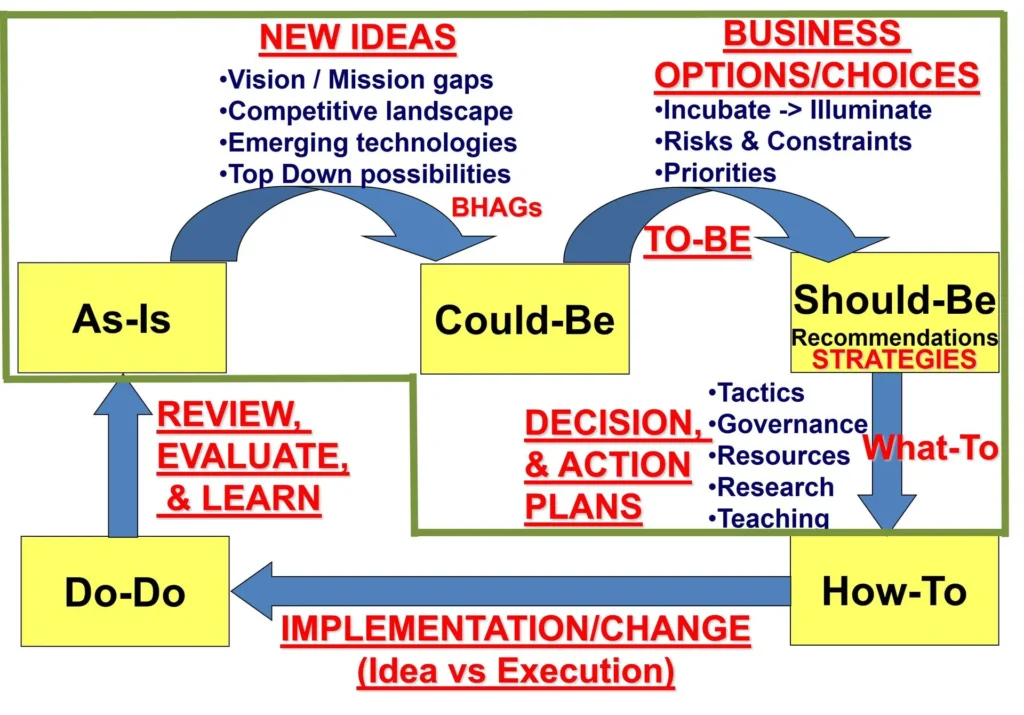
Great digital leaders don’t just execute — they run a repeatable cycle:
Could-Be — Spot new opportunities: vision gaps, emerging technology (especially AI), and market shifts.
Should-Be — Turn ideas into real options and strategy, shaped by risk analysis and prioritization.
How-To — Define the tactics, governance, and resources needed to act.
Do-Do — Execute, backed by strong implementation and change management.
Review, Evaluate & Learn — Assess outcomes and feed insights back into the next cycle.
This program prepares candidates to run that full cycle — not just one piece of it.
Upon successful completion, candidates also receive an ICCP or IOA Certification — and the program prepares candidates for CGEIT® (Certified in the Governance of Enterprise IT) certification through ICCP as well.
Why This Certificate Exists Now
and Agentic AI Digital transformation has changed everything — accelerated by the shift to remote work, online revenue generating commerce, and new expectations around sustainability. But its impact reaches far beyond back-office systems and IT infrastructure, and it isn’t slowing down.
Digital capability now drives revenue and competitive advantage directly. Emerging technologies — AI, robotics, blockchain, and more — combined with a faster-changing business ecosystem (competition, global interdependence, new sourcing models, disruption) have made one thing clear: IT and non-IT leaders can no longer operate in separate lanes. They have to collaborate as one team.
That’s the demand this program was built to meet — professionals with the right balance of leadership, business, industry, technical, and interpersonal skills to lead through this shift.
Every company is becoming a digital company, and that’s reshaping how IT itself is structured and led:
More revenue-generating initiatives now report directly to business units, not to a centralized IT function.
More infrastructure is outsourced, shrinking the traditional centralized IT organization.
Centralized and decentralized IT responsibilities are increasingly viewed as fundamentally different roles.
The net effect: both IT and non-IT roles are being redefined, and leaders on both sides need a real refresh in how they think and manage — not just new tools. IT must deeply understand the business. The business must deeply understand IT. This program is built to close that gap directly, and prepares candidates to step into the CIO role from a strategic, tactical, and operational perspective — for the business, for vendors and service providers, and for the customers ultimately being served.
7 Rules for a High‑Impact CIO Resume
Keep it ruthlessly concise. Two pages max. CIOs are judged on clarity and prioritization — your resume should reflect both.
Cut anything without business context. A title or responsibility on its own adds nothing. Every line should answer: why does this matter?
Quantify scale and impact. Include revenue, headcount, global footprint, and tech complexity for each organization — then quantify what you delivered: cost savings, uptime, modernization speed, cybersecurity gains.
Minimize early-career detail. A short summary is enough. Your leadership story should live in the last 10–15 years.
Lead with business outcomes, not technical tasks. Show how you drove growth, resilience, customer experience, efficiency, and reduced risk.
Show your talent engine. CIOs are judged by the teams they build — highlight how you recruited, upskilled, reorganized, or transformed IT talent.
Make your AI leadership explicit. Boards now expect CIOs to own AI strategy — call out AI governance, automation wins, data modernization, and enterprise-wide AI enablement directly.