
CTO Certification
(Integrating IT Infrastructure Program)
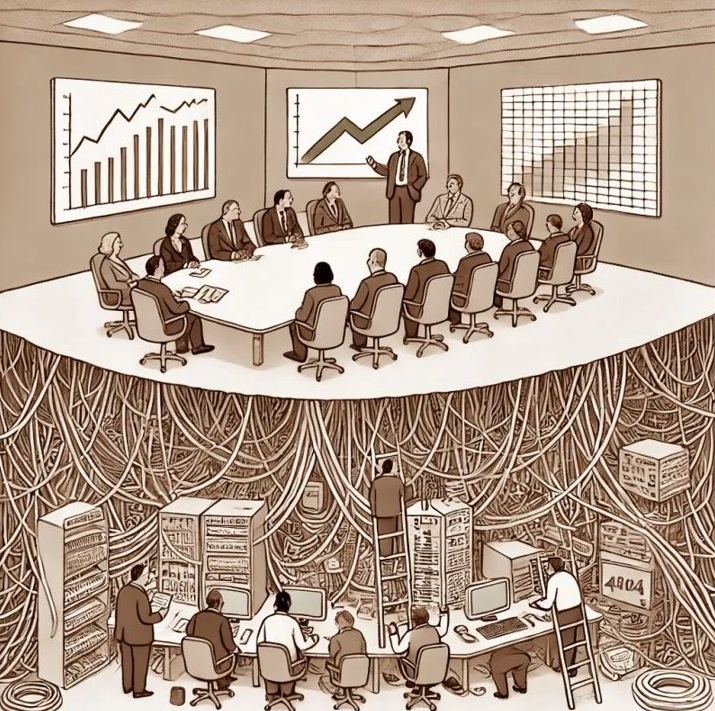
This certificate equips candidates with strategic, tactical, and operational skills in IT infrastructure. It emphasizes methods for deploying, managing, and supporting emerging enterprise systems and architecture, while also covering techniques for defining them and analytics for their assessment. The curriculum centers around the comprehensive ITIL (Information Technology Infrastructure Library) and TOGAF (The Open Group Architectural Framework) models, especially when recognizing that AI adoption is outpacing existing infrastructure.

While the course descriptions are below, click here to find out more about GIIMs CTO Certification Program
Select at least 4 courses from the following:
Information Technology Management or its equivalent.
1. Database Management
Information technology (IT) has become an integral part of today’s professional landscape, as every company becomes a digital company. From strategic front office systems, to support of back office initiatives, understanding these concepts and the impact of emerging information technologies is essential.
This course will focus on what digitization is for IT and non-IT candidates requiring an understanding of these fundamental considerations, how they are and will influence organizations, why they impose specific (and sometimes seemingly absurd) operational processes, and how to use this knowledge to your advantage in your professional life.
This course provides an introduction/overview to systems and development concepts, information technologies (e.g., data, network, infrastructure), and application software. It explains how information is leveraged in organizations and the effects IT has on the organization’s structure, processes, governance, employees, customers, and suppliers. In addition, the course describes how IT enables and drives improvement in quality, timeliness, and competitive advantage.
Grasping the key concepts of IT does not need to be daunting. The course will use real world examples to illustrate key concepts, and strive to strike a proper balance between clarity/amenity and conceptual soundness. Join us on this stimulating journey that will allow you to better understand and perform in your current or desired job.
2. Enterprise Architecture
This course takes a comprehensive IT/CIO perspective of business-IT strategy by addressing the strategic, tactical, and operational roles and responsibilities of IT and non-IT executives in managing IT as a strategic business asset. While the alignment of business and IT is the primary focus, emphasis is placed on the current/emerging issues/opportunities in creating and coordinating the significant Cloud activities necessary to ensure IT’s contribution to the success of the organization. This is done by examining important considerations such as IT governance, IT value, IT processes, IT organizational structure, HR & sourcing, managing emerging technologies, the role of the CIO, and IT-business strategy. By concentrating on ITs strategic responsibilities, in essence this course puts the candidate in the role of the CIO as they build a business strategy that is enabled/driven by IT.
3. Integrating IT Infrastructure & Cloud
This course takes a comprehensive IT/CIO perspective of business-IT strategy by addressing the strategic, tactical, and operational roles and responsibilities of IT and non-IT executives in managing IT as a strategic business asset. While the alignment of business and IT is the primary focus, emphasis is placed on the current/emerging issues/opportunities in creating and coordinating the significant Cloud activities necessary to ensure IT’s contribution to the success of the organization. This is done by examining important considerations such as IT governance, IT value, IT processes, IT organizational structure, HR & sourcing, managing emerging technologies, the role of the CIO, and IT-business strategy. By concentrating on ITs strategic responsibilities, in essence this course puts the candidate in the role of the CIO as they build a business strategy that is enabled/driven by IT.
4. Implementing the Cloud Capable Data Center
This course takes a comprehensive IT/CIO perspective of business-IT strategy by addressing the strategic, tactical, and operational roles and responsibilities of IT and non-IT executives in managing IT as a strategic business asset. While the alignment of business and IT is the primary focus, emphasis is placed on the current/emerging issues/opportunities in creating and coordinating the significant Cloud activities necessary to ensure IT’s contribution to the success of the organization. This is done by examining important considerations such as IT governance, IT value, IT processes, IT organizational structure, HR & sourcing, managing emerging technologies, the role of the CIO, and IT-business strategy. By concentrating on ITs strategic responsibilities, in essence this course puts the candidate in the role of the CIO as they build a business strategy that is enabled/driven by IT.
5. Continuity Planning
This 24 hour introduction to information security provides the foundation for understanding the planning and implementation of policies and procedures for protecting information assets, determining the levels of protection and response to security threats and incidents, and designing an appropriate information security system. It provides the foundation for all other courses in this certificate. Candidates will gain an overview of the field of information security and assurance, and will also learn the necessary knowledge to engage in information assurance activities and procedures. Coverage will include inspection and protection of information assets, detection of and reaction to threats to information assets, examination of pre- and post-incident procedures, technical and managerial responses, ransomware, and an overview of the information security planning and staffing functions. Instructors will also introduce the role of the Chief Information Security Management Officer (CISMO).
Candidates will also master risk management, security planning, and security policy enforcement and auditing activities. Candidates will learn about security guidelines, regulation and legal implications, and standards that apply in information security management, as well as information confidentiality, data integrity, and system availability. The course also presents related concepts such as privacy and business continuity planning. While emphasis is placed on managerial and operational security controls, the course also provides an overview of the current and emerging technical security controls (including AI) applied to access control, operating systems, applications, networks/web, cryptographic solutions, intrusion detection systems, physical security, wireless security, VPNs, digital forensics, and related topics.
The primary objectives of the course are to:
- Understand the importance of information security in business continuity
- Critically analyze security threats and define appropriate technical and managerial controls for these threats
- Understand procedures for ensuring compliance with security policies and standards, establish appropriate systems and plans for security implementation
- Identify legal implications of security and standards for security management
- Recognize the management, organizational, and sourcing considerations for having an effective information security program
- Describe audit and recovery approaches for coping with security breaches
- Provide the foundation Cyber Security knowledge required for the other courses in this certificate
This prerequisite course or its equivalent is required prior to taking any of the other courses in this Certificate.
6. Leadership & Management in the Cloud
This course takes a comprehensive IT/CIO perspective of business-IT strategy by addressing the strategic, tactical, and operational roles and responsibilities of IT and non-IT executives in managing IT as a strategic business asset. While the alignment of business and IT is the primary focus, emphasis is placed on the current/emerging issues/opportunities in creating and coordinating the significant Cloud activities necessary to ensure IT’s contribution to the success of the organization. This is done by examining important considerations such as IT governance, IT value, IT processes, IT organizational structure, HR & sourcing, managing emerging technologies, the role of the CIO, and IT-business strategy. By concentrating on ITs strategic responsibilities, in essence this course puts the candidate in the role of the CIO as they build a business strategy that is enabled/driven by IT.
7. Managing IT Resources
As firms engage in the digital transformation and focus their investments in leveraging information technology for competitive advantage and performance improvements, it is essential to understand how to effectively and efficiently manage their information technology resources. There are numerous choices to be made about managing IT resources and it is essential to ensure IT and non-IT executives across the firm work in harmony.
Experience has made it clear that firms need well-thought out organizational structures, skills, processes, and decision rights to ensure that the decisions about how to leverage IT investments are well thought out and integrated across the enterprise. This course will help candidates understand the fundamental decisions related to the management of IT resources and the types of organizational structures, sourcing, governance, and processes that will help effectively and efficiently attain value to the enterprise. It concentrates on developing the candidates’ competency in current/emerging issues in creating and coordinating the key activities necessary to manage the day-to-day tactical and operational IT functions of an enterprise, as IT becomes ingrained in all aspects of the business.
Topics include:
- Enhancing IT-business alignment
- Strategic, Tactical, and Operational IT governance practices
- Improving IT’s key business processes
- IT organizational structure alternatives
- Demonstrating the value of IT
- Evolving role of the CIO
- Trends in sourcing/outsourcing
- Sustaining systems integration
- Managing emerging technologies and change
- Human resource and skills considerations
8. Security Systems (Select from Cyber Security )
Service Thinking is the set of principles, methods, and tools for the application of science, management, and engineering principles to services – tasks that the organization performs for others. Service Thinking guides the transition of the organization that occurs when the business focus is on the customer’s experience.
Design thinking is a process for creative problem solving. Rather than a one-size-fits-all mindset, it encourages a holistic view where uncertainty and ambiguity are welcomed and embraced as to consider all sides of a problem. A design mindset can be applied to any life situation, and it aids in considering the bigger picture and informatively acting accordingly. Design Thinking and Innovation will teach you how to leverage fundamental design thinking principles and innovative problem-solving tools to address business challenges and build products, strategies, teams, and environments for optimal use and performance.
Service & Design Thinking addresses questions such as how to:
- develop and improve co-creation with customers and become “an intelligent listener”
- recognize design gaps in the service systems of the industry that can provide innovative opportunities
- leverage the core competencies of the organization for services transformation
- approach problems using structured methods of gathering observations, breaking cognitive fixedness, and generating creative ideas for solutions
- apply creative solutions and behavior-change analysis to innovation development and internal team processes
- practice empathy in applying a human-centered approach to design techniques, such as user research, user experience, prototyping, and journey mapping
9. Service Thinking
Service Thinking is the set of principles, methods, and tools for the application of science, management, and engineering principles to services – tasks that the organization performs for others. Service Thinking guides the transition of the organization that occurs when the business focus is on the customer’s experience.
Design thinking is a process for creative problem solving. Rather than a one-size-fits-all mindset, it encourages a holistic view where uncertainty and ambiguity are welcomed and embraced as to consider all sides of a problem. A design mindset can be applied to any life situation, and it aids in considering the bigger picture and informatively acting accordingly. Design Thinking and Innovation will teach you how to leverage fundamental design thinking principles and innovative problem-solving tools to address business challenges and build products, strategies, teams, and environments for optimal use and performance.
10. Network Management
Responding to the accelerating worldwide demand for reliable and robust communications, this course offers a rich panorama of network principles, architectures, trends, and standards. It focuses on the significant opportunities and obstacles facing today’s rapidly expanding enterprises, not only in the US, but also around the world. Candidates are introduced to the global regulatory environment and critical managerial decisions. They become familiar with key emerging technology concepts, CDMA systems, radio resource management, services and applications, and next-generation standards. Attendees are prepared to become skilled communication managers who appreciate performance requirements coupled with the delivery of top quality service, with a deep understanding of current and emerging communications technologies (e.g., 5G and beyond). Topics include Network & Mobile Computing, Global Network Industry, Next Generation Networks, Performance Management, and Continuity Planning.
11. Integrating IT Technologies, Systems & Services
This course focuses on ways of designing and integrating an enterprise architecture. The course explains the different forms of corporate information systems and their interaction. Mainframe systems and large scale clusters will be the focus of this infrastructure. While in the past, mainframe systems were often self-contained, in current systems, it is more likely that such systems are part of an overall architecture including many smaller hardware devices and operating systems. Competing with classic mainframes are large Linux-based clusters; we will discuss their emergence. The student will learn about the building blocks of current enterprise architectures, and then will learn how to connect them to solve the problems of large companies.
12. Enterprise Systems Management
This course offers a broad survey of Enterprise Systems technology and IS management considerations with emphasis on the mainframe. The course takes a strategic management perspective in exploring the mainframe’s architectural capabilities and impacts. Specific topics of study include Introduction to the Mainframe Environment, Total Cost of Ownership, Cost of Downtime, Scalability, Security, Access Management, and Mainframe Careers. Enterprise Systems case studies are explored throughout the course.
13. Green IT
This course presents the across the broad range of issues associated with use of IT to achieve sustainable IT operations and business practices. Energy considerations has become even more important with the advent of AI and growth of IT infrastructure initiatives with their thirst for power/energy. Large tech organizations that are leading the AI race require building and powering ever larger data centers. Candidates should be able to demonstrate their knowledge and understanding of the concepts, issues, techniques and challenges in delivering Green IT including the:
- wider background to Green IT
- establishment a Green IT Policy
- establishment of a Green IT Action Plan
- concepts and techniques for internal assessment
- risks and benefits of Green IT
- techniques and technologies available to enable Green IT
- growth in computing and demand for energy
- role of Green IT across the organization
- roles and responsibilities of key stakeholders
14. Quantum Computing
Digital computers have been making it easier for us to process information for decades. Quantum computers are poised to take computing to a whole new level. Quantum computers represent a completely new approach to computing. While they won’t replace today’s computers for decades, by using the principles of quantum physics, they will be able to solve very complex statistical problems that today’s computers can’t. Quantum computing has so much potential and momentum that it is recognized as one of the next big trends in technology, with the hardware and software required to handle the most complex problems not being generally available until 2035 or later. It is best suited for complex problems like simulating quantum systems in nature, optimization, and cryptographic encoding and decoding. Most companies’ initial foray into quantum computing will be through cloud access. Leading hyperscale cloud providers and specialized startups offer this service today. Some of the most notable ones include IBM, Google, Amazon, and Microsoft. These supercomputers offer a path to fitting a million qubits on a single chip. All the computers in the world today operating together can’t do what a single 1-millioin-qubit quantum computer will be able to do. These new computers could encrypt data, discover new drugs, and tackle complex issues in healthcare and engineering.
Candidates will understand the current and emerging application and impact of quantum technologies. Topics include the current/emerging industry implications and state of development and production of quantum hardware, software, and other products and services that make use of quantum mechanics. Candidates will be exposed to a variety of industry specific and general business software solutions for quantum computing, with a focus on development tools and programming languages, as well as the advancement of quantum consulting services. The course begins with an overview of traditional and quantum computing and quantum physics, followed by a study of the algorithm construction process. A more advanced and technical quantum computing course will dig deeper and require greater knowledge of math, coding, and data science.