Public Sector is not what it was even a few years ago. Understanding emerging information technologies and their impact on government and their constituents, and the roles and responsibilities of IT and non-IT stakeholders in leveraging these emerging technologies in light of the digital transformation, will be at the heart of all of the courses.
As artificial intelligence reshapes how public sector organizations operate, the central question is no longer whether AI will replace human capability, but how leaders will integrate the strengths of both to unlock new levels of innovation, productivity, and government value. The future is not a choice between humans or AI; it is a leadership challenge of orchestrating the best of both.
GIIM’s programs are designed precisely for this moment. They equip public sector leaders to harness the combined potential of human intelligence and artificial intelligence, ensuring each amplifies the other to drive measurable impact.
Examples of AI in Public Sector / Government improving efficiencies, accuracy, and accessibility
Receiving benefits for job loss, retirement, bereavement and childbirth almost immediately
Social insurance service provision
Classifying emergency calls based on their urgency
Detecting and preventing the spread of diseases
Assisting public servants in making welfare payments and immigration decisions
Adjudicating bail hearings
Triaging health care cases
Monitoring social media for public feedback on policies & emergency situations
Identifying fraudulent benefits claims
Predicting a crime and recommending optimal police presence
Predicting traffic congestion and car accidents
Anticipating road maintenance requirements
Identifying breaches of health regulations
Providing personalized education to students & marking exam papers
Assisting with defense and national security
Making symptom-based health Chabot AI Vaid for diagnosis
Public interaction with government and access government services:
Answering questions using virtual assistants or Chabot’s
Directing requests to the appropriate area within government
Filling out forms
Assisting with searching documents (e.g. IP trademark search)
Scheduling appointments
Virtual assistants or Chabot’s being used by government:
virtual assistants respond to questions or reroute to the right person
assist to navigate services
Other uses:
Translation
Language interpretation
Drafting documents
Transcribing speech to text
What Managers need to know
This Certificate gives participants the tools necessary to examine opportunities for leveraging IT in the public sector (Federal, State, and Regional), government agencies, and social institutions in our society, to bring about demonstrable value added change. The certificate combines the theory and practice of government, politics, and policy-making along with trends in information technology for those who desire to make a significant difference.
Discover what managers need to know
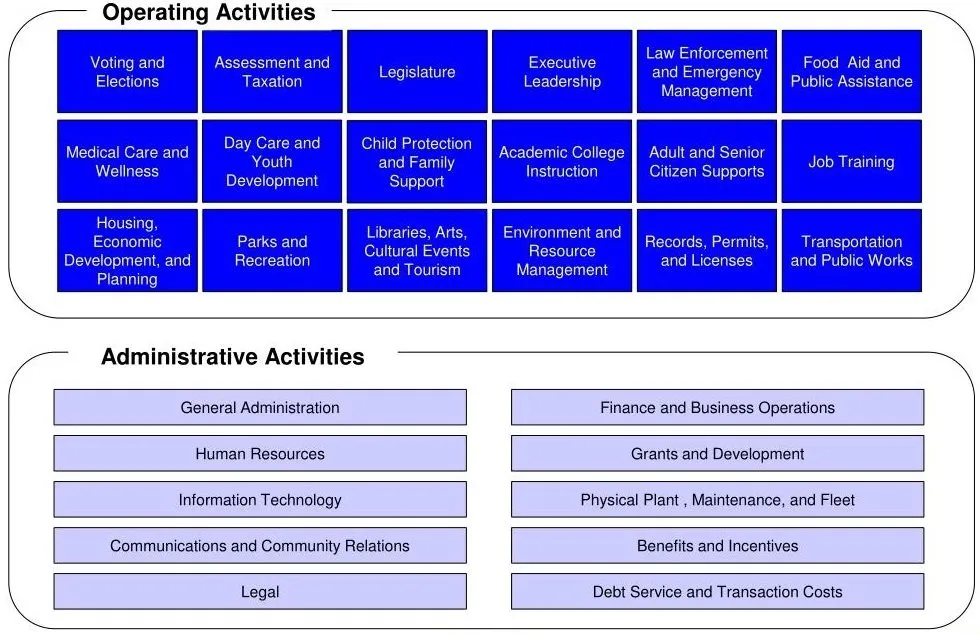
Local Government Value Chain
Naturally, having accurate, accessible, secure data is fundamental to a successful AI initiative, thus providing additional topics addressed in this program. The Digital Government (Public Sector) Certificate focuses on the use of IT to enhance the strategic, tactical, and operational elements across the government value chain.
Customized Programs
Address Management Competencies
The certificate focuses on how to address the bureaucratic decision-making process at the federal, state, regional and local levels, while understanding how an administration (the collective body of employees a particular government entity houses) works collaboratively, effectively, and multilaterally with the benefit of the community and individual in mind, to build effective and efficient IT strategies that leverage emerging technologies. Why decisions are made and in what manner (as well as under what degree of collaborative effort) are incorporated throughout this certificate. The courses are designed for IT and non-IT professionals in government whose roles involve leveraging digital/smart government opportunities to provide demonstrable value from their IT investments, in light of the digital transformation and emerging information technologies (e.g., AI, blockchain, social media, analytics, big data), while addressing important considerations like providing a secure infrastructure and hybrid work environment.
During the course of study participants will be able to examine public sector management or policy issues, while understanding how the use of various entities within government structure may be used to come to a proper solution. Candidates will study policy analysis, to a degree of being able to conceptualize and interpret existing and future IT policy, as well as manage IT policy implementation in accordance to risk, uncertainty, and risk preference. Candidates will be able to understand how new policy concepts may mesh with existing policy and law, as well as how it interfaces with the spectrum of public affairs, public perception, and public reception. Opportunities to leverage new technologies like social networking and cognitive computing to engage citizens are fundamental in today’s ever-changing world.
Discover management competencies
Discover management competencies
Smart City
Management Competencies
For city and local government candidates, the focus will be on creating strategies and plans for smart cities that are securely connecting their constituents and infrastructure while effectively and efficiently leveraging all sources of data/information. The program will address every layer of a city, from underneath the streets, to the air that citizens are breathing, whileworking in conjunction with everything from IoT sensors to open data collection (e.g., smart streetlights) to provide better services and better communication. Data from all segments of the city/government is analyzed to identify patterns and derive recommendations/solutions from the collected data. Topics like smart energy, smart transportation, smart data, and smart infrastructure will be addressed, as will the use of IT across all government agencies (e.g., education, transit, health, justice, sanitation, public utilities).